01 Start under the surface
Everything visible about a lawn is decided a few inches below it. Grass roots live in a thin band
of soil, and if that band is airless, waterlogged or out of balance, no amount of seed or
fertiliser on top will fix it for long. The first job is not shopping. It is finding out what you
already have.
Compaction is the most common problem and the most overlooked. Foot traffic, dogs, a heavy mower
or simply a high clay content squeezes the pore spaces out of soil, and those pores are where air
and water move. Roots will not push into ground that has none. A crude test works well: after
rain, push a long screwdriver into the lawn. In healthy soil it slides in six inches with light
pressure. If it stops dead at two, you have found the reason that patch keeps thinning.
Then there is pH, which sounds like a laboratory concern and is really a shopping decision. Soil
pH governs whether the nutrients already sitting in your ground can be taken up at all, and most
turf grasses do their best work somewhere between 6.0 and 7.0. Drift far outside that and
phosphorus becomes chemically unavailable, so the fertiliser you buy is partly wasted. A test
from a county extension office costs very little, and its most useful function is telling you
what not to buy.
Drainage, and what puddles are telling you
Water that stands on a lawn for hours after rain is a drainage message, not a weather one. It
usually means a compacted layer, a low point in the grade, or heavy subsoil left behind by
construction. Roots sitting in saturated ground cannot breathe, and the patch that drowns in
March is the patch that browns first in July.
Core aeration — pulling small plugs of soil out and leaving them on the surface — is the standard
answer for compaction, and it is best done while the grass is growing strongly. For low spots, a
thin topdressing of compost applied over two or three seasons will raise the level without
smothering what is already growing.
If moss shows up in the same corner every spring, note it now. That corner is telling you about
shade, damp and acidity all at once.
02 Match the grass to your climate and light
A lot of disappointing lawns are simply the wrong plant in the wrong place. Grass seed is sold
nationally, but grass grows regionally, and the split between cool-season and warm-season types is
the most useful thing to understand before you buy a bag of anything.
Two families, two calendars
Cool-season grasses. Kentucky bluegrass, tall fescue, perennial ryegrass and the fine fescues grow hardest in the
cooler halves of the year. They green up early, put on strong growth through spring and again
through autumn, and coast or go semi-dormant in high summer heat. Their weak point is prolonged
heat and drought, when they will often brown off and wait rather than die.
Warm-season grasses. Bermuda, zoysia, St. Augustine, centipede and buffalo grass do the opposite. They love heat, grow
most strongly through midsummer, and turn a straw colour after the first hard frost — which is
dormancy, not death. They spread by runners rather than clumps, which makes them good at closing
their own gaps.
Between those zones runs a wide band across the middle of the country where neither family is
entirely comfortable: cool-season grass suffers in August, warm-season grass looks dead from
November to April. If you live there, tall fescue and zoysia are the names worth researching
first, and a few weeks of imperfect colour is part of the deal.
Sun exposure is the other half of the decision, and it is where people are least honest with
themselves. Count the hours of direct sun a patch actually receives at mid-morning, midday and
mid-afternoon. Most sun-loving turf wants six or more. Fine fescues and St. Augustine handle
shade better than most, but no grass thrives under a mature maple while competing with tree roots
for water. Match the grass to its wear, too: children and dogs need a tough, self-repairing type.
03 Sowing and overseeding that takes
Seed germinates when it is in contact with moist soil. That single sentence explains almost
every failed reseeding job. Scattering seed across a mat of thatch or over hard, dry ground mostly
feeds birds, and the handful that does sprout dries out before it roots.
Water and timing for a new sowing
Water new seed differently. New seed is the one exception to everything below about deep watering. Until it germinates, the
top half-inch of soil has to stay damp, which usually means a light misting once or twice a day
rather than a soaking. Once seedlings are up and mowed twice, taper toward deeper, less frequent
watering.
Timing beats effort. Sow cool-season seed in late summer or early autumn: the soil is still warm, the air is cooling
and weed competition has faded. Sow warm-season seed in late spring, once soil temperatures have
risen. Overseeding once a year, rather than waiting for a lawn to fail, is a cheap way to keep
density up.
04 Water deeply, not daily
A short sprinkle every evening feels responsible and does more harm than good. It wets the top
inch of soil, which is exactly where the roots then decide to stay, and a lawn with one-inch roots
is a lawn that panics the first hot week of summer. Deep, infrequent soakings pull roots downward
into soil that stays cooler and holds moisture for longer.
How much, and how to measure it
The working figure most extension services use is about an inch of water a week including
rainfall, delivered in one or two long sessions rather than seven short ones. Put three
straight-sided containers — empty tuna cans are the classic — around the sprinkler's reach and
time how long it takes to collect an inch. Now you know your own sprinkler, which beats any
general rule.
Water early in the morning. Grass dries as the sun comes up, less is lost to evaporation, and the
blades are not left wet overnight — the condition most lawn fungal diseases prefer.
Learn the thirst signals so you can water on demand instead of on a timer: footprints that stay
visible for more than a few seconds, a dull blue-grey cast, and folded blades. In a hot spell
many cool-season lawns go dormant and brown rather than die, then green up when rain returns.
Deciding in advance whether to irrigate through that is a choice, not a failure.
05 Height, the one-third rule and sharp blades
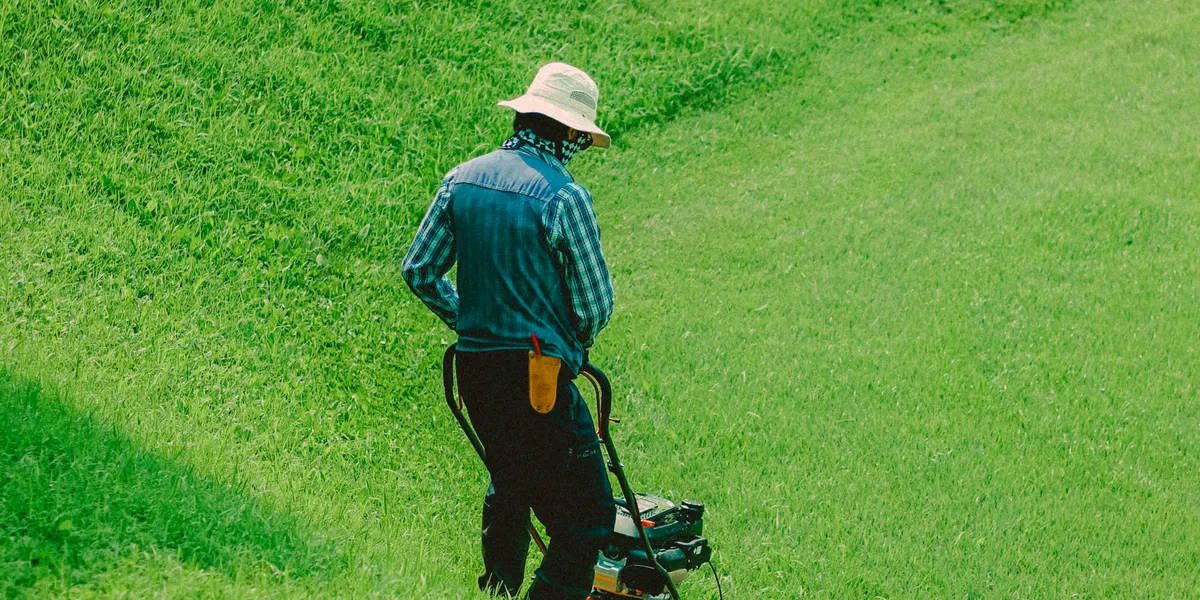
Mowing is the job people do most often and think about least, and it shapes how a lawn looks more
than fertiliser does. Three decisions matter: how high, how much at once, and how sharp.
Mow high. For most cool-season home lawns, somewhere around three to four inches
is a good working range; bermuda and zoysia are normally kept shorter. A taller blade shades the
soil, photosynthesises more so the plant can invest in roots, and crowds out weed seedlings at
ground level. A lawn cut short looks tidy for two days and thin for the rest of the month.
Follow the one-third rule. Never remove more than a third of the blade height in
a single pass. Scalping strips the plant of the leaf area it needs to recover, exposes the
crowns, and leaves gaps that weeds move into within a fortnight. If the lawn got away from you,
bring it down over two or three cuts spaced a few days apart.
Keep the blade sharp. A dull mower blade tears grass instead of cutting it. Look
at your lawn a day after mowing: ragged, whitish-brown tips mean a blunt blade. Torn tips lose
more water and invite disease, and sharpening two or three times a season is enough for most
homeowners. Unless the grass is very long or wet, leave the clippings where they fall — they
return nitrogen to the soil and are not what causes thatch.
06 Feeding, and the rhythm of the seasons
Fertiliser is a supplement, not a rescue. It works when the grass is actively growing and has
the root system to use it, and largely goes to waste when it does not.
When to feed, and how
When to feed. For cool-season lawns the autumn feeding is generally the most valuable of the year: top growth
is slowing, but roots are still active and storing energy for spring. A lighter spring feeding
supports the first flush. For warm-season lawns the useful window runs through late spring and
summer. Feeding a dormant lawn of either type mostly feeds the weeds.
How to feed without regret. Follow the rate on the bag rather than your instincts — more nitrogen produces soft, fast growth
that needs more mowing and is more prone to disease. Slow-release formulations give a steadier
result than a quick green-up. Sweep stray granules off paths so they do not wash into drains, and
check local rules, since some states restrict phosphorus or set blackout dates. Compost
topdressed in autumn is a slower route to the same place.
07 Thatch, moss, weeds and bare patches
Most lawn problems are symptoms. Treating the symptom without changing the condition that
produced it is how people end up doing the same repair every single year.
Three symptoms worth reading correctly
Thatch. Thatch is the spongy layer of undecomposed stems and roots between the green growth and the soil.
Under about half an inch it is useful. Thicker than that and it sheds water and fertiliser before
either reaches the ground. The usual causes are over-feeding and compaction, not clippings, and
core aeration in the growing season is the gentlest fix.
Moss. Moss does not attack grass, it moves into space grass has given up. Shade, poor drainage,
compaction and acidic soil are the usual invitations. Scarify it out and the patch looks better
for a season, but unless you open the canopy, aerate or adjust the pH it returns. Sometimes the
honest answer is that a fern bed would be happier there.
Weeds and bare patches. Dense turf is the most effective weed control there is, because weed seeds need light at soil
level to establish. Broadleaf weeds spreading through a lawn are usually reporting thinness rather
than causing it. Spot-treat rather than blanket-spray, and read the label for your grass type.
For bare patches, loosen the top inch, mix in compost, sow, cover lightly and keep it damp.
08 The habits that keep lawns thin
If you recognise several of these, you are in ordinary company. Cutting too short, because short
looks neat on the day. Watering a little every evening. Buying whatever seed mix was nearest the
till instead of one suited to the region and the light. Guessing at fertiliser. Feeding a dormant
lawn. Reseeding a patch that floods every spring without touching the drainage.
There is one more worth naming: changing everything at once. If you aerate, reseed, re-time the
watering and lower the mower in the same month, you will have no idea which change helped. Pick
the two most likely to matter for your site — usually soil and watering — hold them steady for a
full growing season, and you will learn more about your own ground than any guide can tell you.
Good grass is not a secret product. It is depth of root, density of plant and a bit of
patience, and every practice above is really just a different way of buying one of those three.